Instant PDF download. Read it on your phone, tablet or computer.
A PDF guide for Nigerian sellers

Stop overpaying middlemen. Import from China with ₦100,000 or less.

A step-by-step guide that shows you how to find suppliers, order safely, ship, clear customs and price your stock, even if you're already selling locally.

30 pages, 14 chapters Instant download after payment Secure checkout on Selar
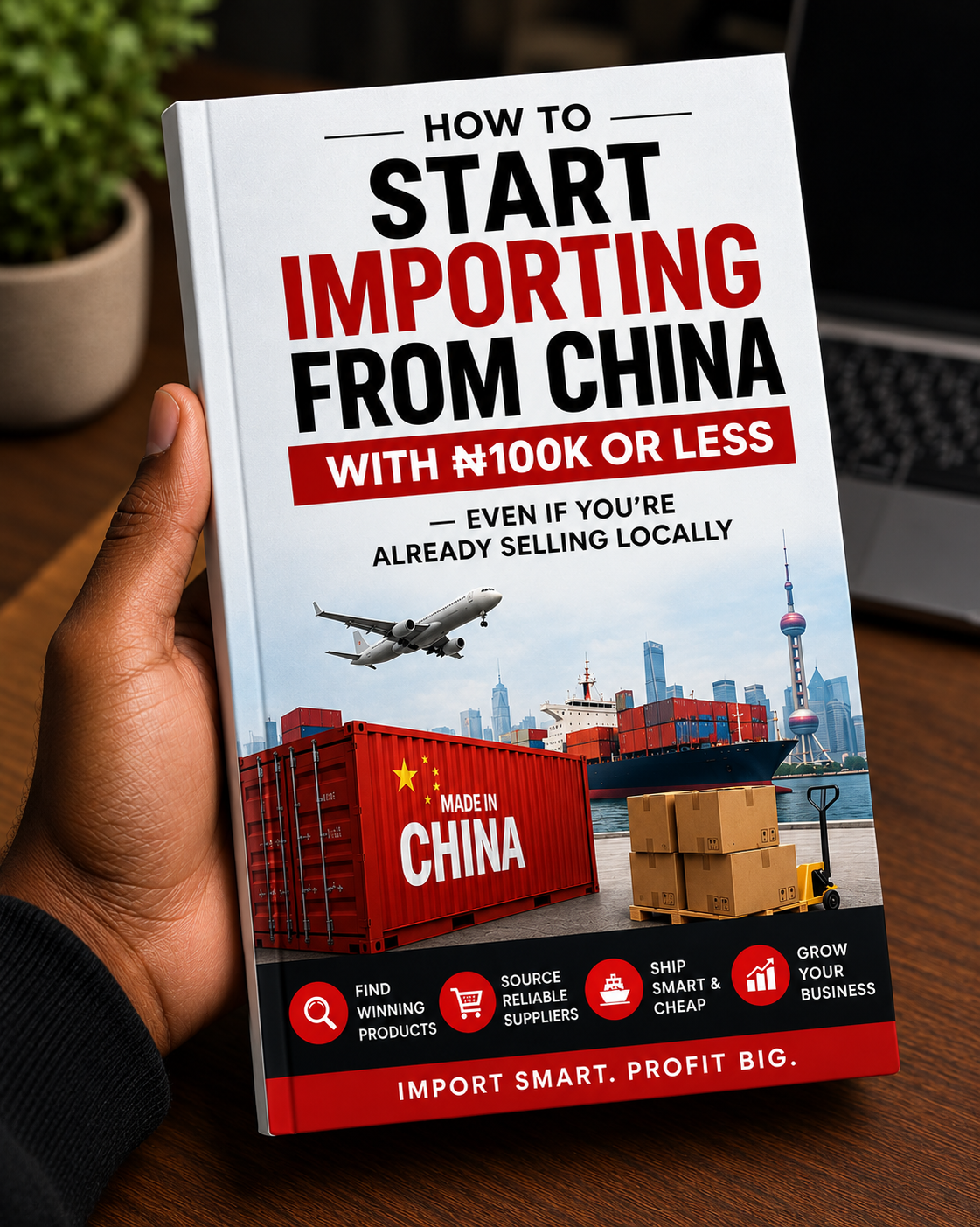
Cover of the book How to Start Importing From China with ₦100K or less
Import smart.
Profit big.
30pages of step-by-step guidance
14chapters, intro to action plan
4copy-and-send message templates
10steps to place your first order
18point printable checklist

Why your margins are so thin

You buy from someone who bought from someone who bought from the factory. Every hand adds a markup, and you pay for all of them.

ProductLocal wholesaleFactory price (bulk)Gap
Earphones (basic wired)₦800 – ₦1,500₦150 – ₦3003–5x
Fashion sunglasses₦1,500 – ₦3,000₦350 – ₦6003–5x
Small handbags₦4,000 – ₦8,000₦1,200 – ₦2,2003–4x

Illustrative ranges from the guide, before shipping and customs. Your numbers depend on your product, supplier and order size.

That gap is where your margin lives. This guide shows you, step by step, how to reach the factory side of that table and keep more of it for yourself.

Get to know me

I used to take someone else's word for what my stock cost.

I'm a business owner, just like you. For a long time, I bought my stock through people based in China who said they were buying directly from the factory for me.

I paid what they told me the factory price was. I had to take their word for it.

That works, until you start asking the questions every business owner should ask:

  • What is the real factory price?
  • What am I actually paying for?
  • How much of my money is going to the middleman?

Then I learned how importing really works: how to find and vet suppliers myself, how to order safely through Alibaba's Trade Assurance, how shipping and customs work in Nigeria, and how to work out my true cost per unit.

Once I understood the process, I stopped depending on anyone else's word. I could see for myself what things should cost, and I made my own decisions.

I put everything I learned into this guide, in plain language and in the right order, so you can skip the guesswork. I'm not promising you riches. I'm giving you the knowledge to take control of your own imports.

OTI BROS HUBBusiness owner and publisher of Import Smart

What you'll be able to do

Each chapter takes you one step closer to a first order you can place with confidence.

Know your numbers first

See what ₦50k, ₦100k and ₦150k realistically buy, and how to calculate your true landed cost per unit before you spend.

Pick a product that can sell

Use a simple 6-factor scorecard to compare product ideas and choose a safe first import.

Find suppliers you can trust

Vet suppliers on Alibaba, use Trade Assurance and learn the red flags that protect your capital.

Order with confidence

Follow a 10-step walkthrough and copy ready-made messages for inquiries, samples, negotiation and freight forwarders.

Understand shipping and customs

Air vs. sea, working with an agent, HS codes, Form M, PAAR and the full Nigerian duty breakdown, explained plainly.

Price, sell and reinvest

Set prices that beat local wholesale, choose where to sell, and reinvest so your business grows past shipment one.

Guessing vs. having a process

Most first-time importers lose money on small, avoidable things. Here's the difference a clear process makes.

Without a processWith the Import Smart guide
Factory pricesTake someone's word for what things costShortlist 5–8 suppliers and compare their quotes yourself
Choosing a productPick whatever looks exciting or "hot"Score ideas on demand, margin, weight, durability, repeat purchase and your familiarity
Paying suppliersSend money and hope for the bestPay through Trade Assurance, so your payment is protected until you confirm receipt
Shipping and customsGet surprised by clearing fees at the portKnow the full duty stack and get an all-inclusive landed-cost quote before you ship
Setting your priceGuess a selling priceWork out landed cost per unit and price against local wholesale

Built for Nigerian sellers, not copied from a generic course

Everything is explained from a Nigerian importer's point of view, in naira and in plain language.

Naira budgets

Three budget tiers (₦50k, ₦100k, ₦150k) with realistic splits for product, shipping, clearing and buffer.

Nigerian customs

HS codes, Form M, PAAR, NICIS II and how duty is calculated on CIF value at the official exchange rate.

Local market research

How to check demand using Jiji, Instagram shops and wholesale markets like Trade Fair, Balogun, Alaba and Idumota.

Where to sell

WhatsApp Status, broadcast lists, Instagram and Facebook shops, Jiji and local markets, with retail and wholesale price tiers.

Everything inside the guide

Fourteen chapters, a glossary and a printable checklist, written in plain language. Page numbers shown on the right.

  1. IntroWhy import?The math behind cutting out the middleman4
  2. Ch. 1What your budget actually gets you₦50k, ₦100k and ₦150k tiers side by side6
  3. Ch. 2Finding and scoring winning productsA 6-factor scorecard to pick your first product8
  4. Ch. 3Sourcing on Alibaba and 1688How to vet suppliers before you pay10
  5. Ch. 4Placing your first Alibaba orderA 10-step walkthrough, click by click12
  6. Ch. 5Message templates suppliers answerInquiry, sample, negotiation and freight forwarder14
  7. Ch. 6Incoterms and payment termsEXW, FOB, CIF, deposits and T/T explained16
  8. Ch. 7Avoiding scams and red flagsWhat to walk away from, and how to protect your money17
  1. Ch. 8Shipping smart: air vs. seaAgent or DIY, with a first-shipment checklist18
  2. Ch. 9Customs and clearing in NigeriaHS codes, Form M, PAAR and the full duty stack19
  3. Ch. 10Case study: one product, start to finishA full worked example with numbers21
  4. Ch. 11Pricing and reselling for marginLanded cost, price tiers and where to sell23
  5. Ch. 12Reordering and scalingGrowing past your first shipment25
  6. Ch. 13Common first-timer mistakesSix costly errors and how to avoid them26
  7. Ch. 14Your 30-day action planWeek-by-week steps from research to sales27
Appendix A: Glossary of importation terms Appendix B: Printable quick-reference checklist

Try before you buy: a free taste of the guide

Here are three small pieces taken straight from the guide, so you can see exactly how practical it is.

From Chapter 7

Red flags to walk away from

  • Prices dramatically lower than every other supplier for the same product
  • A supplier who insists on payment outside Alibaba's system
  • No verifiable business registration, address or years of activity
+ 3 more red flags, and how to protect yourself on every order, inside.
From Chapter 2

The 6-factor product scorecard

  • Existing demand
  • Margin potential (is the gap 3x or more?)
  • Weight and size
  • Durability in transit
  • Repeat purchase potential
  • Your familiarity with the buyer
Score each idea from 1 to 5. The guide shows you what to ask for each factor.
From Chapter 5

A message suppliers actually answer

Hello, I'm interested in [product name/link]. Could you share your price per unit at [quantity, e.g. 100 pcs] and at [quantity, e.g. 500 pcs]? Please also confirm: minimum order quantity, production time, whether a sample is available and its cost, and your available shipping methods to Lagos, Nigeria. Thank you.
Plus templates for samples, negotiation and freight forwarders.

Try it: your landed cost calculator

The guide teaches you to know your true cost per unit before you set a price. Enter your own numbers below. It's pre-filled with the guide's example, so you can see how it works.

Add what you pay locally now to see the difference.
Landed cost per unit₦0
Total landed cost₦0
A common starting price (2x landed cost)₦0
Add your local wholesale price to compare.

An estimate only. Duty, freight and exchange rates change, so confirm your numbers with your supplier and freight agent.

The guide shows you how to get every one of these numbers, step by step.

Get instant access

A peek inside: where your money goes

Chapter 1 breaks down a first order for small, lightweight products such as phone accessories and fashion items. These are illustrative ranges.

₦50,000

Test run to learn the process
Product cost
₦28k – ₦30k
Shipping (air)
₦12k – ₦15k
Clearing / duty
₦6k – ₦8k
Buffer
₦3k – ₦5k
30 – 60 small units

₦100,000

The sweet spot for a first real order
Product cost
₦55k – ₦60k
Shipping (air)
₦20k – ₦25k
Clearing / duty
₦10k – ₦12k
Buffer
₦6k – ₦8k
100 – 200 small units

₦150,000

More stock, better unit prices
Product cost
₦85k – ₦90k
Shipping (air)
₦28k – ₦32k
Clearing / duty
₦14k – ₦16k
Buffer
₦10k – ₦12k
200 – 350 small units

Heavier or bulkier products raise the shipping share and reduce how many units your budget covers. Always confirm current prices with suppliers and freight forwarders before committing funds.

See the process worked out in numbers

Chapter 10 follows one example product from research to resale. Here's the cost side of that worked example.

Chioma's wireless earphones

A fictional Lagos phone-accessories seller with a ₦100,000 budget
Product: 150 units × ₦320 (via Trade Assurance)₦48,000
Air freight, 11-day transit₦22,000
Clearing: duty, surcharge, FCS, ETLS, VAT, agent fee₦14,000
Total landed₦84,000
Landed cost: ₦560 per unit, against a local wholesale price of ₦1,500 – ₦2,000. Figures are illustrative, not a promise of results.

Landed cost per unit

(Product cost + Shipping + Customs/Clearing + Other fees)
÷ Total units received

The duty stack, explained in Chapter 9

  • Import dutyRate by HS code × CIF value
  • Surcharge7% of duty
  • FCS4% of FOB value
  • ETLS0.5% of FOB value
  • VAT7.5% of CIF + charges

Is this guide right for you?

This guide is for you if…

  • You already sell (clothes, accessories, beauty, home items) and want better margins
  • You're a beginner with ₦50,000 to ₦150,000 and want to start the right way
  • You're nervous about scams, shipping or customs and want a clear process
  • You prefer starting small, learning, then scaling

It's not for you if…

  • You expect guaranteed income or overnight riches. No honest guide can promise that
  • You want to import heavy machinery, full containers or regulated goods right away
  • You're not willing to start with a small first order and learn from it

Your first 30 days, mapped out

You won't be left guessing what to do next. Chapter 14 turns everything into a week-by-week plan.

1

Research and validate

  • Shortlist 3–5 product ideas that already sell
  • Check local wholesale prices
  • Create your Alibaba account
2

Vet suppliers and sample

  • Message 3+ verified suppliers
  • Compare price, MOQ and production time
  • Order a sample if budget allows
3

Order and arrange shipping

  • Confirm price and quantity
  • Pay through Trade Assurance
  • Get 2+ freight quotes and book
4

Receive, price and sell

  • Clear goods with your agent
  • Calculate true landed cost
  • Set your price and set aside reorder capital

Mistakes that cost first-time importers money

Chapter 13 covers these in detail, and the rest of the guide helps you avoid them.

Choosing a product before doing the math

A "hot" product means nothing if the landed cost leaves no room for profit.

Skipping the sample order

Bulk ordering without checking quality can mean finding problems after your capital is gone.

Not budgeting for customs duty

Forget the surcharge, FCS, ETLS and VAT layers and your margin "disappears" at clearing.

Paying outside the platform's protection

Moving payment off Alibaba removes your only real safety net if something goes wrong.

Import Smart guide cover

Get the Import Smart guide today

  • 30-page PDF guide with 14 chapters
  • Budget breakdowns for ₦50k, ₦100k and ₦150k
  • Copy-and-send message templates for suppliers and freight forwarders
  • Nigerian customs and duty breakdown
  • Full worked example with numbers
  • 30-day action plan, glossary and printable checklist
  • Instant download, read on any device
Get instant access

Secure checkout on Selar. You get the download right after payment. Not sure yet? Ask us on WhatsApp first.

1Tap the button to open the secure Selar checkout
2Pay and download your PDF straight away
3Start with the Introduction, then follow the 30-day plan

Questions you may have

I'm a complete beginner. Can I follow this?
Yes. The guide starts from the basics and builds chapter by chapter, with checklists at the end of each one. It's written in plain language for people who have never imported before.
Is ₦100,000 really enough to start?
The guide shows how a ₦100,000 first order can be split between product, shipping, clearing and a buffer for small, lightweight products. Heavier or bulkier items cost more to ship, so the guide also helps you choose products that fit your budget. Figures are illustrative, and you should confirm current prices before you pay anyone.
What if I only have ₦50,000?
The guide includes a ₦50,000 tier and treats it as a test run: the goal is to learn the whole process on a small amount of capital, then reinvest with more confidence on your second order.
Will I be guaranteed to make a profit?
No. Importing involves supplier reliability, exchange rates, shipping times and customs, and results depend on your product, capital, negotiation and consistency. The guide gives you a clear, careful process and teaches you to start small, so a mistake is one you can afford.
Will I still need an agent?
For most first-timers, yes. The guide explains that a licensed clearing agent handles Form M, PAAR and NICIS II filings, and it recommends using a freight forwarder for your first shipments. It shows you what to ask them, how to compare quotes and how to sanity-check the duty calculation, so you never accept a number blindly.
Do I need to speak Chinese or have a registered business?
No. The guide recommends starting on Alibaba, which works in English, and notes that you can set up your profile even if you're not yet a registered business. For customs, it explains how a licensed clearing agent handles the paperwork for you.
What kinds of products does it suit?
It's built around small, lightweight, non-fragile items such as phone and gadget accessories, beauty tools, fashion accessories, kitchen and home gadgets and kids' items. The guide advises avoiding heavy, bulky, fragile or certification-required products for your first shipments.
Are the prices and duty rates up to date?
The figures in the guide are illustrative estimates based on typical ranges, and real prices, freight costs, exchange rates and duty rates change. That's why the guide teaches you to confirm current costs with suppliers and freight forwarders and to ask for an all-inclusive landed-cost quote before you ship.
What format is it, and can I print it?
It's a 30-page PDF. After payment on Selar you can download it straight away and read it on your phone, tablet or computer. Appendix B is a printable quick-reference checklist, and you can print any other page too.
I'm outside Lagos. Does it still apply?
Yes. The guide covers importing into Nigeria in general, and the freight forwarder template can be adapted for Lagos, Abuja or other destinations.
I have another question. Who do I ask?
Message us on WhatsApp at 0805 303 2756 and we'll point you in the right direction.

Your first import starts with one decision.

Stop buying at middleman prices. Get the step-by-step guide and plan your first order with confidence.

Get instant access
Import Smart

Import smart. Profit big. A practical guide to sourcing and importing products from China into Nigeria. Published by OTI BROS HUB.